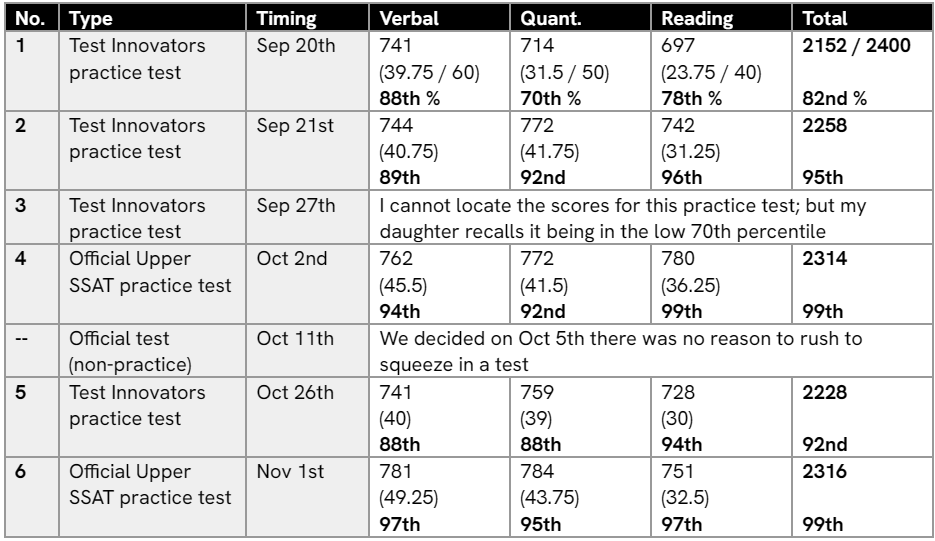
Here's the brass tacks context: Our daughter took the SSAT. She took it once. She scored: 2316 / 2400 (97th percentile); link where we share further score details. We struggled with baselining her score (read more about how/why below). She began studying in late September. She did not take preparatory classes, nor did she do private tutoring. We helped her study (and while the SSAT was as new to us as it was to our daughter, we both did well on our respective SATs—albeit a long while ago, and therefore figured we would be adequately positioned to help without the need for a tutor).
Now for a more detailed take about our experience, and the emotional, strategic, logistical, and psychological aspects at the heart of SSAT preparation. We stepped into SSAT prep with a mix of ambition and worry. We endeavored to support our daughter without burning her out. We wanted to impress the importance of making time for what may feel like tedious practice for this relatively high-stakes test, while maintaining tempered expectations and perception about the end-result score, so as to mitigate against creating undue and unwarranted stress.
This article is organized into seven sections: the emotional reality of SSAT prep, understanding the shape of the SSAT, diagnosing your child's starting point, building a 3-6 month plan, preparation mistakes, the psychological side, and tools and resources. The blog also includes anecdotes from our experience—which are separated by three asterisks (***), to bifurcate between content that is presented to be informational vs. to share / commiserate.
The Emotional Reality of SSAT Prep
The SSAT feels high stakes. For schools that use it in decision-making, fact is that it matters—at minimum to create a baseline, on-paper understanding about your child's academic prowess. And because it's comparative, whatever your perception of a less-than-ideal score may feel like an indictment of your child's academic prowess.
The reality is that the SSAT is scored and translated into a percentile that ranks your child against others who have taken the test. The test being score-based is definitive in a way, but by no means defines a child. Because the other reality is that there are so many other circumstances influencing each child, and their score, that it would be unfair for you and your child to use SSAT scores as any means of comparison, except as a singular data point that will be eclipsed by so many other data points in your child's academic life.
It is important to consider what goes into an SSAT score: some kids will have had months—possibly even more than a year—of tutoring. Some kids will be naturals at test-taking; some will need to work tremendously hard for a "good" score; and some will work hard, but will not ultimately get their desired score. Some will come into the SSAT with a rich vocabulary from being a voracious reader and will be able to devote more time to math than critical reading and verbal. Some will need to devote time to all three sections (in addition to writing).
The point of this section is hopefully to highlight that there is so much about the SSAT that you and your child cannot control—and should therefore not feel bad about. What you can control is the reasonable degree to which you help your child feel prepared for and confident(ish) about taking the SSAT.
Understanding the Shape of the SSAT
The SSAT has a particular personality:
- Verbal is vocabulary-heavy and old-fashioned
- Math is "gotcha" prone (even students with straight As in math can feel blindsided)
- Timing is tight
- Reading is dense
These features should be a reminder about why prep can feel frustrating. Your child isn't "bad at math;" the SSAT describes problems in a way that is meant to trick even the most cautious of test takers. Neither is your child "bad at vocab;" the SSAT will use words that are not heard outside of literature from the 1950s. Oh, and beyond using words that are not often used, the verbal section—like the math one—will also try to trick you by presenting synonym options that are nuanced and require an exacting definitional understanding of the original word.
Below are a couple of examples we came across where the SSAT was being deliberately tricky:
Math example #1: What is the value of the underlined digit: 471.0296?
(A) 20 ten thousandths (<5% selected this answer); (B) 2 thousandths (13%); (C) 20 thousandths (31%); (D) 20 tenths (15%); (E) 2 hundreds (39%) // Correct Answer: (C) 20 thousandths
Math example #2: Let events X, Y, and Z be independent events. If P(X) = 0.2, P(Y) = 0.5, and P(Z) = 0.1, what is P(X or Y)?
(A) 0.1 (10%); (B) 0.2 (13%); (C) 0.5 (14%); (D) 0.6 (23%); (E) 0.7 (40%) // Correct Answer: (D) 0.6
Math example #3: A large soiree has a perimeter of 720 centimeters. If 36 identical small squares are used to make up the larger square, what is the side length of one small square?
(A) 2 cm (7%); (B) 5 cm (28%); (C) 10 cm (6%); (D) 20 cm (30%); (E) 30 cm (29%) // Correct Answer: (E) 30 cm
Verbal example: A synonym for "gist" is: (A) detail; (B) opinion; (C) summary; (D) tangent; (E) point. Ngl, this is one my daughter got wrong on a practice exam; and when she read the options out loud to me, I confidently blurted out: "option c: summary," without bothering to listen to the rest of the options. My husband listened to all the options, and selected the correct answer: "option e: point."
The SSAT is uniquely designed to be tricky and nuanced. It's what differentiates students scoring in the 80th vs. low/mid-90th vs. high-90th percentiles. The bad news is: the SSAT is tricky—and will always be tricky to those who are not natural-born test takers (like my husband). The good news is: the SSAT becomes a lot easier and less daunting once your child is at least aware of the fact that the test is meant to be tricky.
Diagnosing Your Child's Starting Point
One to two full mock tests are helpful to baseline where your child needs help. Two points to consider: (1) I suggest one to two tests because you may want to use the second test as your baseline—especially if the SSAT (and these types of standardized, timed tests) are completely foreign to your child (as they were to mine). (2) The individual and composite scores (and corresponding percentile) are helpful to indicate where your child may want to allocate extra prep time to prepare; but what is also important to look for are:
- Timing problems (e.g., "I ran out of time on every section;" "I ran out of time on the math sections only;" "I finished all the sections with ample time, but got many wrong.")
- Stamina issues (e.g., "I started flagging after 90 minutes;" "I found it difficult to context switch between the quantitative and qualitative sections;" "I got really hungry by the second hour.")
- Section-level gaps (e.g., math fundamentals? vocabulary? Reading speed?)
- Emotional response (e.g., "This was overwhelming;" "Okay, not terrible.")
Answering these "feeling" and "state of mind" questions—along with your baseline score and time left to prepare—is where your personal SSAT preparation and plan originates.
***
An anecdote from our experience, for what it's worth: Our daughter ended up taking the test without me feeling reasonably confident about what her "baseline" was. This lack of clarity did not really change the way we prepared for the test; for selfish anxiety-mitigation reasons, I would have preferred knowing—with more confidence—the range where I could expect my daughter's score to land.
The reason why we had trouble baselining our daughter's score was because there was always at least one thing that threw off each practice test:
Test no. 1: Went in cold—never having taken any similar type of test. We also did not bother contextualizing the test—meaning, she was unaware of the types of questions, the nature of questions, and that the SSAT is written to be tricky. She was generally aware of the sections—including that the Writing section is not scored, and about approximately how many questions there were in each section.
Test no. 2: This test was originally meant to serve as our actual baseline—once we had spent some time on Saturday (after test no. 1) contextualizing the test. The "thing" that—in my opinion—threw this test off, was that our daughter encountered a technical glitch that prevented the site from properly capturing her verbal section responses—which she then added back with the time remaining in the section. I also personally did not trust this score because, frankly, it seemed too high relative to the score she achieved the day before.
It's worth noting here that we originally wanted to plan for our daughter to take the October test, and were assuming she would need to take the test again in November.
Also, for what it's worth, see: SSAT Vocab for how we prepared for the SSAT Vocab section, as well as for a summary of the debate my husband (a natural test taker) and I had with our daughter about verbal section strategies.
Test no. 3: If the previous week could not serve as our reasonable baseline, *this* test surely would—except that we left our daughter to entirely manage herself during this test.
For context, for the first test … I sat in the same room with Nora for the entirety of the test. I did not interact with her. I caught up on some work at my desk—in the kid's study room, which is side-by-side to the desk where my daughter took her test. My only interactions with my daughter were: to periodically ask her > to stop humming because she would not be able to do that during the test; and once, to tell her she had 5 minutes remaining for the writing portion—to which she responded: "actually, I have 6 minutes; and I can see how much time is left from this clock that is provided."
For the second test … I made sure to wake my daughter up, feed her breakfast, confirm she was comfortable in the room she would spend > the next three hours in, and checked in with her once during the break.
For the third test … Here's what I figured would happen: our daughter now knew the drill, and I could use the time to clean and prepare for the next week (my husband was away for the morning, taking our youngest to swim class). All I did was to let my daughter know it was 8:00 AM, and that she needed to wake up and begin her test in the next hour (beginning at 9:00 AM Eastern), so make sure we had the afternoon free for other commitments.
Here's what ended up happening for test no. 3: My daughter woke up at 8:50 AM. She came downstairs to drink some water, grabbed her computer, and rushed back upstairs to get set up. Halfway into the test, she switched locations; she brought her computer downstairs because it had died midway into her third section. By this time, her brother had come down and began to putz around the kitchen and living room area (I sent him back upstairs after breakfast, requesting he try not to distract his sister). Shortly after, my husband and our youngest came back, at which point I requested our daughter simply take both computer *and* charger to finish her test upstairs. Aside from the disruption from having to change locations, our daughter expressly admitted to becoming severely distracted during the test, and losing sense of time.
The *thing* here is obvious. And while I acknowledge—that during the test, I cannot control how distracted my daughter (known for her distractibility) may become, I also see how her poor test taking conditions exacerbated this whole practice attempt.
Test no. 4: The original plan was to take two more tests before the October 11th SSAT: one on Wednesday afternoon (the only day that is reliably free from at least extracurriculars—if not also homework, assuming our daughter could spend much of Monday and Tuesday doing homework known to be due on Thursday / Friday); and one on the Saturday or Sunday before the official test the following week. Our daughter did well, but even by test no. 4, we did not have a comfortably consistent baseline.
Our decision point—knowing we did not have to send the score (if we did not like it), and putting aside the cost to register (and register late): should our daughter take the October test?
We decided against taking the official test. It would have been taken for the sake of having a healthy, controlled "practice" test that we could finally use as a confident baseline. Ultimately, we decided it was extra emotional stress and simply time that we needed for other, more time-sensitive application priorities (namely interview preparation).
The "thing" on this test was being surprised by my daughter's math section (she was also very surprised). What seemed to trip her up were the math word problems. Her take was that it's not that she did not know how to do the underlying math (in almost all cases, she did); rather, she was not used to word problems—which she said were not really tested—as a format, on the Test Innovators practice tests or modules.
Tests no. 5 and 6: Notice the time skips. They were not strategic. Ideally, my daughter would have fit one or two more practice exams in during this period. The time skips were a function of prioritizing interview prep and campus tours, and simply not having the time of day to allot toward SSAT prep.
Ultimately, our daughter's SSAT score is what it is. Regardless of the outcome, we are super proud of: the concerted and honest effort our daughter made to prepare for the SSAT; her attitude about the whole experience—and the relative seriousness she had about the test; and her resilience around not stewing too long or unproductively in her own feelings of anxiousness and disappointment. She remained focused (with parental help) on preparing for the SSAT as best as she reasonably could—given the amount of time we had to devote to the effort, while keeping in mind that the SSAT is an important component to her application, but not the only one.
Building a 3-6 Month Preparation Plan
The above anecdote notwithstanding, I wish we started on SSAT preparation well before when we actually did. At the risk of making SSAT prep feel like a long and drawn-out effort—and having your child feel tired/sick of it by the time test day comes, SSAT prep is one of these things that you can control the most—on your time schedule.
As a reminder, we did *not* pay for a preparatory service or tutor. We are not against it; and it likely would have helped tremendously. As for why we did not: we felt like we did not have enough time—for even private tutoring, to be more helpful than just helping our daughter ourselves; and second, we felt that the extra, scheduled formality, would create time pressure/commitment that we could not accommodate during our already over-packed fall semester schedule.
If a preparatory service or tutor feels right for you, I suggest starting by baselining your child's performance in the spring or summer before you plan to take the SSAT. And from there, any of these test prep services will help you have an opinion about the duration and frequency you may need their tutoring service.
If given another opportunity to help our daughter prepare for the SSAT (without a tutor), here is how I'd structure our time:
Weeks 1-4: Foundation Phase
- General contextualization about the test
- Review math fundamentals
- Get a few rounds of reading practice in (especially if your child is not used to reading about more dry topics)
- Light vocabulary—ideally based on root-based words
- One to two mock tests to establish a baseline, and get a sense for the "feelings" and "state of mind" of your child
In my opinion, this is actually a 1-2 week effort; there is not much to be gained—and actually probably more of a risk of losing momentum and interest by dragging this phase out.
Weeks 2/4 - 12: Skill-Building Phase
- Weekly vocabulary sets
- Section drills—with time constraints
- Monthly full-length tests
- Strategy lessons/practice (e.g., when to skip vs. guess; pacing; annotating)
- Personally, I don't think time needs to be devoted to the Writing section during this phase, since it's not graded (but I counsel becoming at least familiar with the section, and aware of a few example prompts)
The point of this phase is to practice—not only the sections themselves, but also with various strategies, to get a sense for what your child feels is right for them and best serves them.
For example, if critical reading is a concern, does your child feel more prepared by glancing at the questions first, and then reading the passage; or does it work better to glance at the article first, then read through each question one-by-one, and then search for/validate the answer through a more detailed, secondary read of the passage; or is time best served by doing a close read of the passage—while annotating and underlying, before diving into each question?
The second point of this phase is to create breathing room to learn and practice (so your child isn't trying to do it—for the first time, concurrently with doing the application and keeping up with school).
The third point of this phase is to allow for the runway and option—if you decide, to hire a tutor or preparatory service.
Point being: time gives you flexibility and options—in addition to helping to manage the undue stress caused by feeling like you don't have enough of it to adequately devote to SSAT prep.
Final 4-6 Weeks: Refinement Phase
- Focus on "stubborn" areas
- Full-length tests every 2-3 weeks
- Begin emotional prep: manage test anxiety and build confidence
- Practice writing samples under time conditions (especially if your child isn't used to or does not enjoy writing, twenty-five minutes is not much time to: structure a response while almost simultaneously, writing a few mildly cogent paragraphs)
However long your SSAT prep plan ends up being, the goals for an optimal rhythm should be: consistency, low-drama/controlled stress, and predictable.
Above, I link to a post about SSAT Vocab; in addition, see: SSAT Essay Writing for my daughter's experience with the Writing section, along with a few of her examples.
Preparation Mistakes
- Over-testing too early (practice tests are diagnostic; not homework)
- Ignoring verbal—because it feels archaic, and is difficult to put into real/sustained practice
- Not addressing stamina
- Treating every wrong answer or "bad" score as a catastrophe or personal indictment
- Focusing on score vs. trajectory
Your child will eventually plateau, even if at scores that may not be within your child's desired range. That's normal. It's fine. What matters is the direction and net improvement over time. Aside from being mentally—perhaps physically—tired from preparing for the SSAT, there is only upside to having had prepared. Your child should be proud of the effort. Your child will have gotten a flavor for the SAT that's around the corner. And fingers crossed, a handful of those vocab words will stick!
The Psychological Side
For anxious children: Make timing less scary. Allow for enough practice tests to do so; and try practicing in "timed chunks," rather than full sections.
For perfectionist children: Emphasize that SSAT math and to an extent—the verbal section, is designed to trick even strong students. A few wrong answers can still mean a top percentile score.
For children lacking confidence: Celebrate effort and improvement—even if it may feel small to your child or you.
For parents: Temper your anxiety; your emotional temperature may have an outsized impact on how much pressure your child feels. Ideally, your child simply feels supported by you.
Tools and Resources
I am not in a position to recommend specific companies. For transparency, I will share the resources we used and why.
We used two resources: (1) ; and (2) .
Private tutoring was always in the back of my mind—but nothing we seriously considered or looked into.
And stating the obvious, in addition to Test Innovators, there are myriad options, including practice books:
XXX [enter affiliate links / amazon affiliate links here ?]
Official SSAT Resources
Link(s): https://www.ssat.org/
Cost: $80 / includes four full-length official practice tests (three of which are available on the Test Innovator Valedictorian level), 15 practice section tests, 50+ quizzes
How we used it: We used it namely to gain access to the full practice tests.
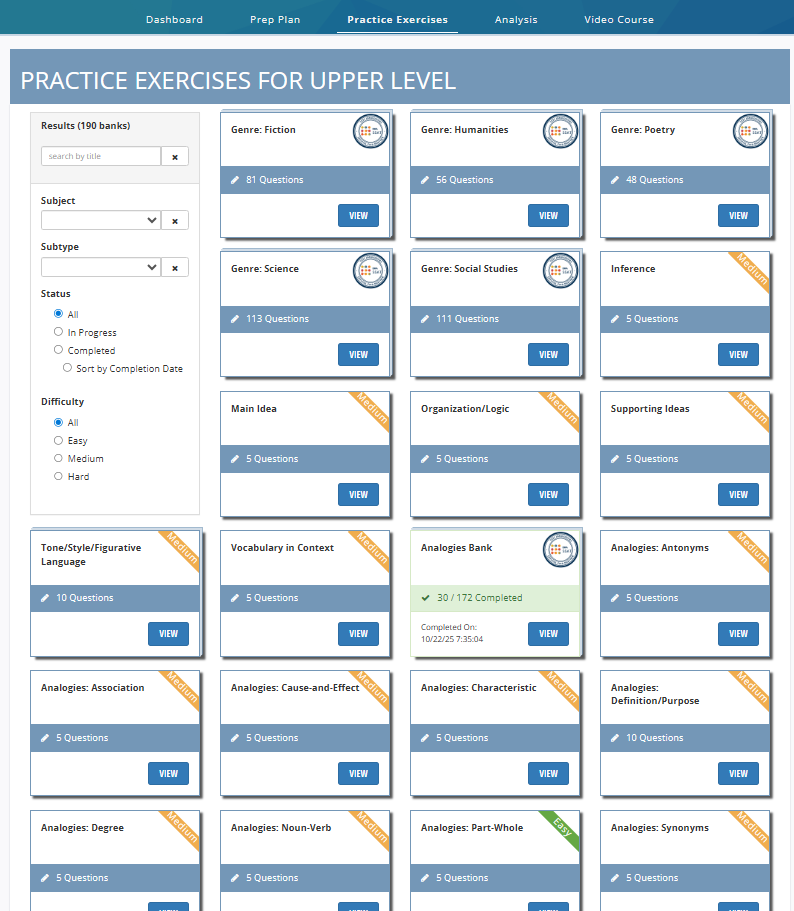
My daughter did not find the modules too helpful; her opinion—of both the math and verbal practice sections, is that they were far easier than their practice tests.
As corroboration, the weekend before taking the official November SSAT, she went through all the math practice modules (we forgot these existed until then). She got all but one question right—which does *not* stack up to the number of questions she was consistently getting wrong during practice tests. As further evidence—also during the weekend before taking the official November SSAT (and also because we forgot these practice modules existed until then), my daughter logged only three net new words she was unfamiliar with, whereas on any given practice exam, my daughter would log upwards of fifty words she either had never seen, or had varying (but not full) confidence about.
The practice tests are clutch (in my opinion). For whatever reason—that seems to be well-guarded, only the official SSAT/PSAT/SAT organization seems to be able to create the tests they administer. With so many examples, one would not think it'd be so hard to replicate the official exams; but from what we reviewed (during SSAT prep with our daughter), and from what I recall (from my personal SAT prep), non-official practice exams may resemble official practice exam—but in a way that seems once or twice removed (or sometimes worse) from the original image AI chat has been asked to replicate.
Non-official practice exams seem to exist in the uncanny valley—or suffers from "the soap opera effect," when your hotel TV adds extra frames to smooth out original movie footage (typically best shown at 24-frames per second) to match the TV's higher refresh rate (often 60Hz or more).
As such—and given we had only four official Upper SSAT practice tests, we used them sparingly.
Test Innovator Resources
Link(s): https://testinnovators.com/
Cost: Free (access to one mini sample test); Starter ($89 / includes 1 full-length practice test); Scholar ($309 / includes 3 full-length practice tests); Valedictorian ($419 / includes 6 full-length practice tests + official EMA practice tests (three of them), videos and practice modules)
Contents: Dashboard; Practice Exercises / Modules; Video Courses
How we used it: We got the most expensive plan to gain access to the full portfolio of practice modules and tests. We did not end up using the diagnostic tools or counseling that is also offered. These are likely helpful—so please do not read into our non-use of these features as anything beyond simply not using them.
Why I ended up landing on Test Innovators: There seemed to be a consensus online that Test Innovators is the priciest, but most helpful, and most like the SSAT. I read a few of opinions that Test Innovators actually felt harder than the actual SSAT ended up being (for their respective children).
My daughter's opinion: Similar to the official SSAT resources, the modules seemed way easier than the practice Test Innovator tests. She also remarked on the notable lack of word problems—which comprise a meaningful set of questions on any given SSAT. And although she also cannot put her finger on it, the Test Innovator modules and practice tests are similar to, but do not stack up to the official SSAT practice tests.
To be clear, I am glad we invested in this, and our daughter was happy to have the practice.
As another aside: the site itself is well-organized.
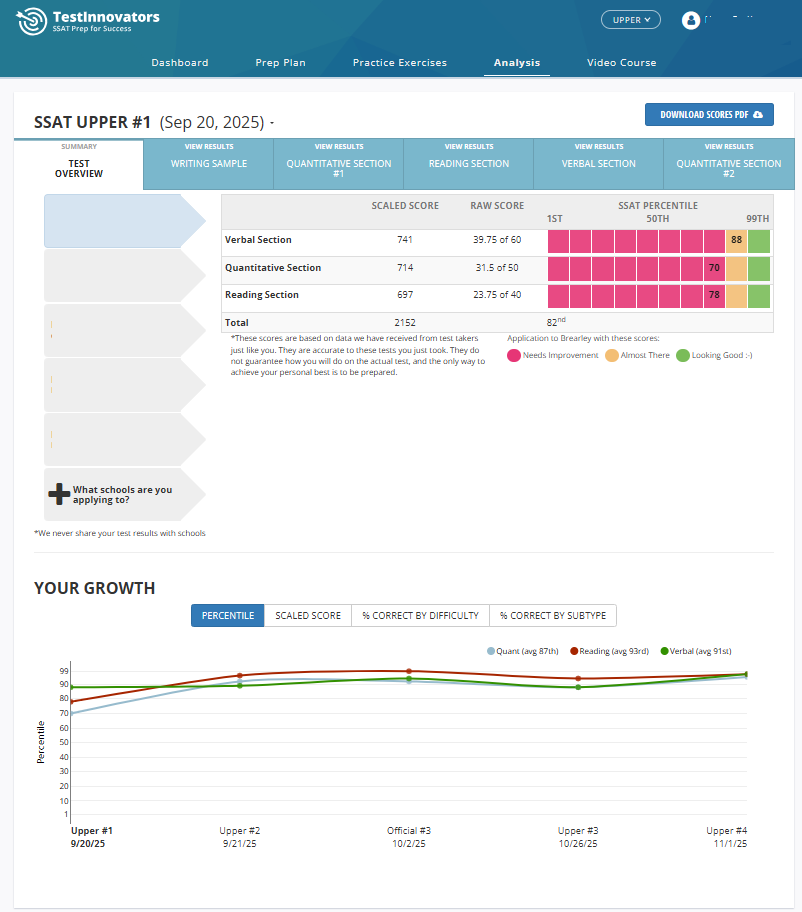
Test Innovator Site >> Analysis Tab
Test Innovator Site >> Practice Exercises Tab
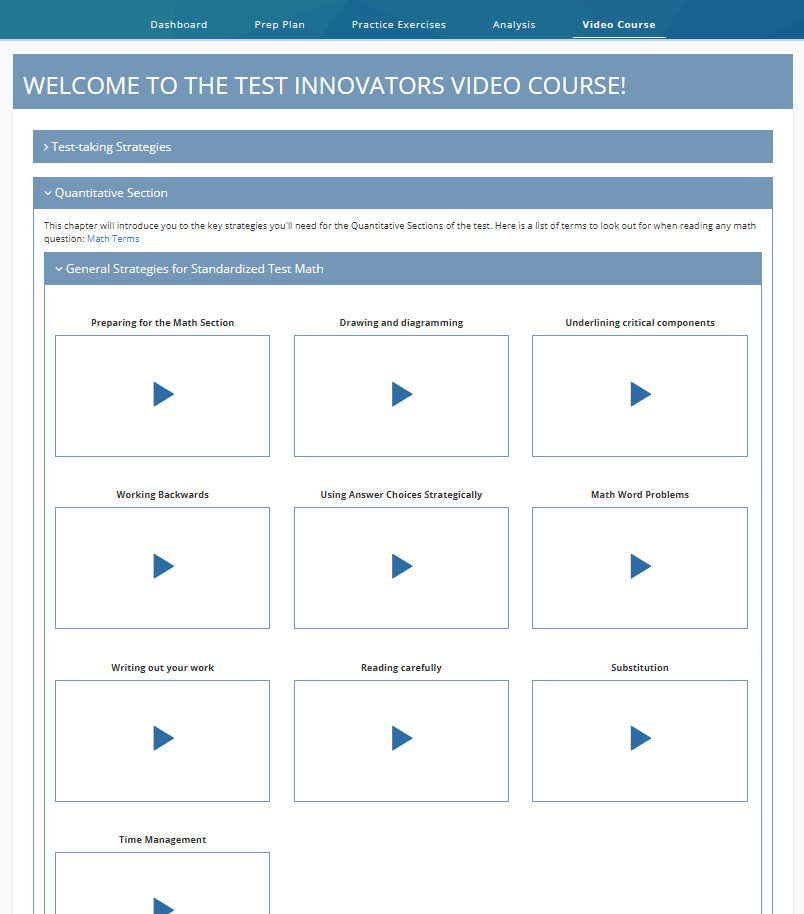
Test Innovator Site >> Video Courses
Here is my neutral breakdown:
DIY Prep:
- Affordable
- Parent-guided
- Requires structuring the plan yourself
- Requires a non-immaterial amount of parental time to not only help your child stay on schedule, but also to review wrong answers and explain why they're wrong (also meaning: be prepared to relearn some math and words)
Tutor-supported Prep:
- Useful for accountability
- Helpful for kids needing structure of specialized review
- Sometimes helpful if your child's baseline score is already pretty "good" and your child is fighting for points at the margins
Conclusion
The SSAT matters. But it's not a referendum on your child's intelligence or future. It is a snapshot of readiness under timed conditions—no more, no less. Your goal is not to create a perfect test taker. Your goal is to help your child show up with calm confidence, good habits, and a practiced self-belief.