This article shares data, insights, and visualizations meant to help you get a sense for the scope and nature of student essays. It is organized into four sections: (i) qualitative insights; (ii) grounding stats and themes; (iii) a few visualizations; and (iv) assumptions / examples.
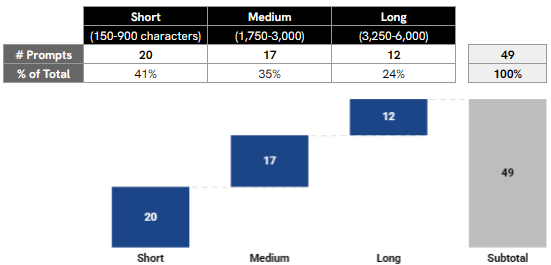
It is important to note that the 'themes' around which essay prompts are organized were devised by me (and not the schools); similarly, the concept of 'short,' 'medium,' and 'long,' and each respective character threshold / range are also mine. I wanted a way to organize 49 distinct prompts in a meaningful and digestible way. My assumptions and examples are laid out below (which you can use as a data point to recontextualize data presented in this article).
Qualitative Insights
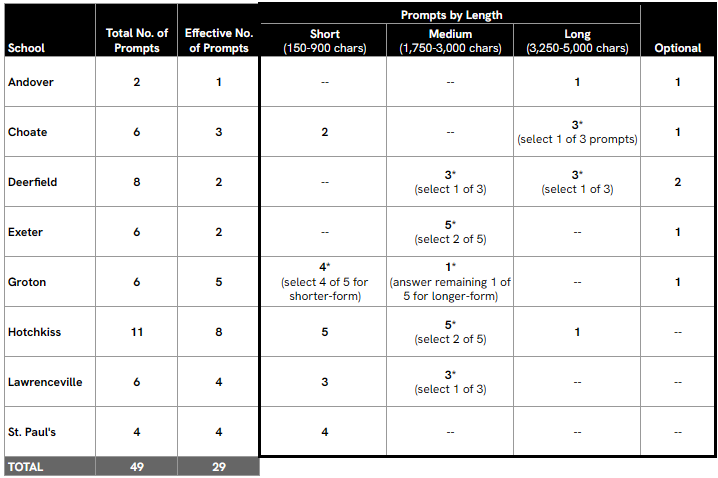
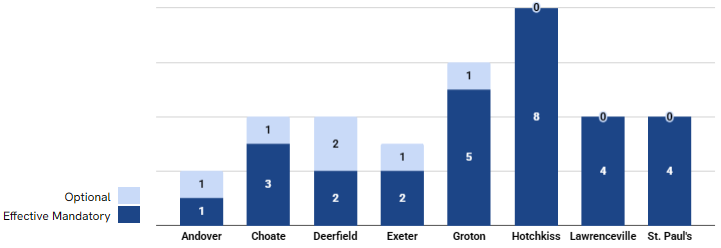
Across eight schools, applicants encountered a combined 49 essay prompts; but more meaningfully, the number is: 29, which are the actual, mandatory prompts an applicant must write, once you account for those 'select X of Y' prompts and strip out optional ones. The gap between 49 and 29 is itself a finding; a significant portion of what schools present is a menu of choices, designed to let applicants self-select the prompts that suit them best.
The variation in workload across schools is striking. One school asked for a single essay of up to 4,500 characters (c.900 words or 1.8 pages single-spaced). Another asked applicants to complete eight distinct responses spanning from micro-prompts of 150 characters (c.30 words) all the way up to a long-form essay limited to 5,000-characters (c.1,000 words or 2.0 pages single-spaced). One school's entire written application consisted of four short(ish) responses.
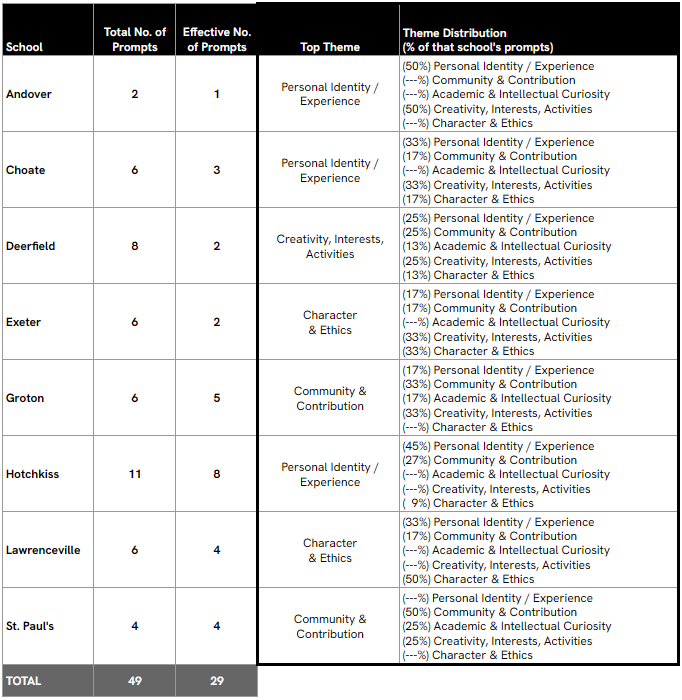
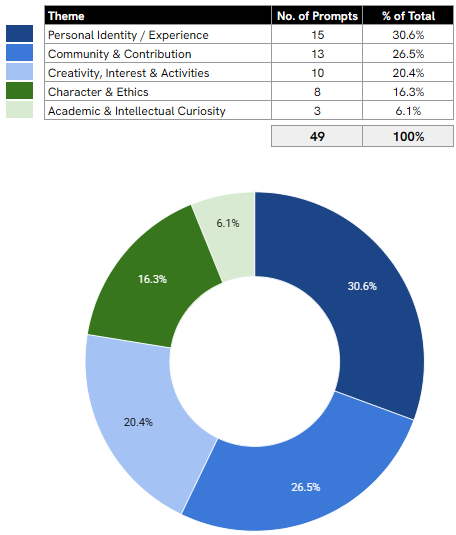
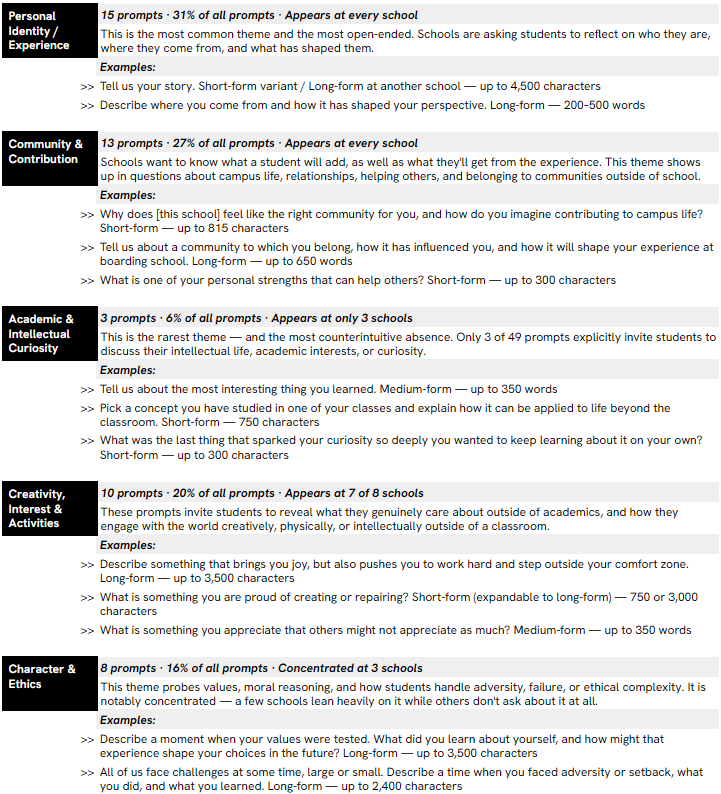
A counterintuitive finding is that only three of 49 (6%) prompts asked about academics / intellectual curiosity. My 'read' of this is that: through an applicant's scores and grades, each school is operating under a working assumption that an applicant will be able to do the work. What is therefore more important to glean is an understanding of who the applicant is, and whether / how the applicant will contribute something meaningful to a community of other high-achieving students.
The dominant theme across all 49 prompts is: Personal Identity / Experience, appearing in 15 (31%) prompts—or nearly one in three. Community & Contribution is a close second at 13 (27%) prompts. Together, these two themes account for nearly 60% of everything applicants are asked to write.
Many schools allow applicants to note anything else. These optional prompts are free-form, unconstrained by draconian character counts, and are meant to be a catch-all. Optional does not mean skip it. My daughter used hers to note disparate points, ranging from hobbies to an update about her rock climbing competition standing.
Grounding Stats and Themes
(For definitions and examples of what is meant by each theme, and the approximate character >> word / sentence / page conversion, see the last section)
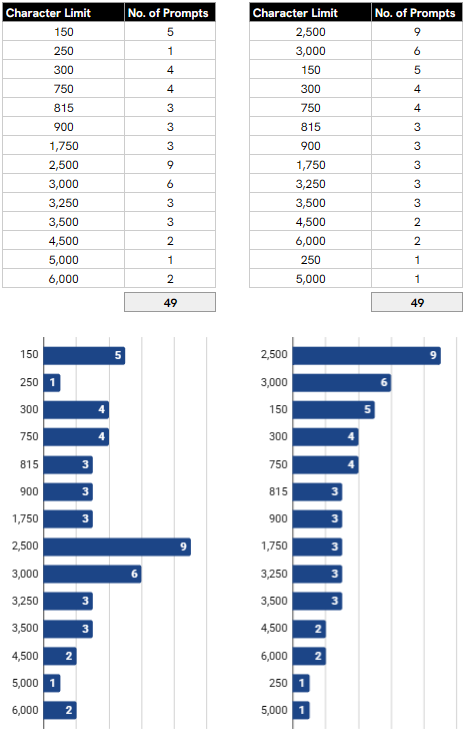
Student Essay Prompts - By School, and Character Limits / Length
Notes
- (1) 'Total No. of Prompts' = number of prompts, including all prompt options (e.g., select 1 or 2 of XX prompts to answer) and optional prompts
- (2) Asterisk (*) denotes where prompt selection options are offered
- (3) Effective No. of Prompts = number of prompts - excluding prompt options and optional prompts, that must be answered by student applicants
- (4) Theme categories created and assigned by me
Student Essay Prompts - By School, and Theme
Visualizations
Student Essay Prompts - By Theme
Student Essay Prompts - By Character Limits
Student Essay Prompts - By Essay Length
Student Essay Prompts - By Effective Mandatory vs. Optional Prompts
Assumptions / Examples
Theme - Short Definitions
Personal Identity and Experience: Many schools sought deep personal reflections on the applicant's background and growth; for example, asking applicants to describe their upbringing and how it impacted them, reflect on an experience that shaped their lives, or describe a core facet of their personal story.
Community and Contribution: Several schools focus one or multiple prompts around how the applicant will engage with the school's environment. Prompts frequently asked about contributing to campus life, belonging to a community, or exploring specific features of the school.
Academic and Intellectual Curiosity: Prompts about favorite subjects, books, global issues, and classroom interests.
Creativity, Interests, and Activities: Prompts about extracurriculars, things they would teach, things that make them laugh, and other prompts sparking creative thinking.
Character and Ethics: A couple of schools asked applicants to describe moments when their values were tested, or when they faced adversity or disappointment. Stating the obvious, the response should also conclude with the "thing learned."
Theme - Example Prompts
Two to three anonymized examples per theme, drawn from actual prompts across the 8 schools. School names withheld; prompts lightly paraphrased where needed to prevent direct attribution.
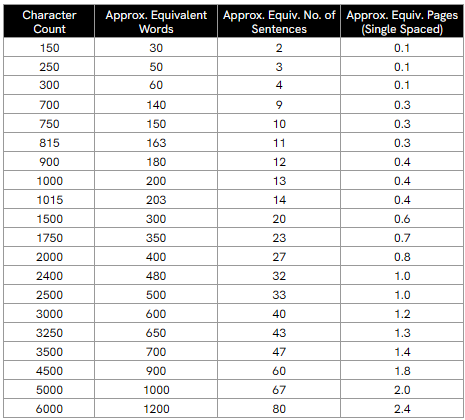
Character Count - Conversion to Equivalent Words / Sentences / Pages (single-spaced)
Most schools noted a character limit; a couple schools framed the limit in terms of words.