Not counting the one day school my daughter applied to, we did seven on-campus visits, six in-person / on-campus interviews, one in-person / semi-local interview, and one virtual interview over the span of seven weeks. And we missed two school days while doing so. Of all our kids, not by deliberate design, our daughter has the most extracurricular activities. We also have three kids, who go to three different schools, and other regular work and family commitments.
All this to say: it was really tough fitting these trips in during the Fall semester; nonetheless, we considered it a priority in order to get a real sense for each of these schools that we were still lacking from browsing websites.
In this article, I write about our approach to and observations / experiences throughout this process. This article is organized into three sections: (1) our approach; (2) what to expect: observations without editorial; (3) observations with light editorial.
1. Our Approach to Campus Tours
When my daughter double-downed on her interest to pursue boarding school (following Exeter Summer), I personally did not account for needing to squeeze in campus visits. My husband — who went through the boarding school application process (albeit years ago) — lobbied strongly for making it a priority. His counsel was that when he applied (from California) to Exeter, Andover, and Groton, it was only after he visited each school that he was able to form a substantive opinion about cultural / academic fit. Doing in-person visits also helped him feel more invested and committed to the idea of boarding school — which, at the onset, was mostly a suggestion from his England-native father who had gone to boarding school himself.
This first section is organized into three parts: our schedule, our strategy, and our preparations.
Our Schedule
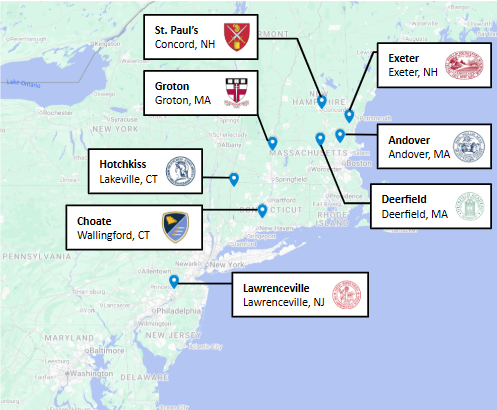
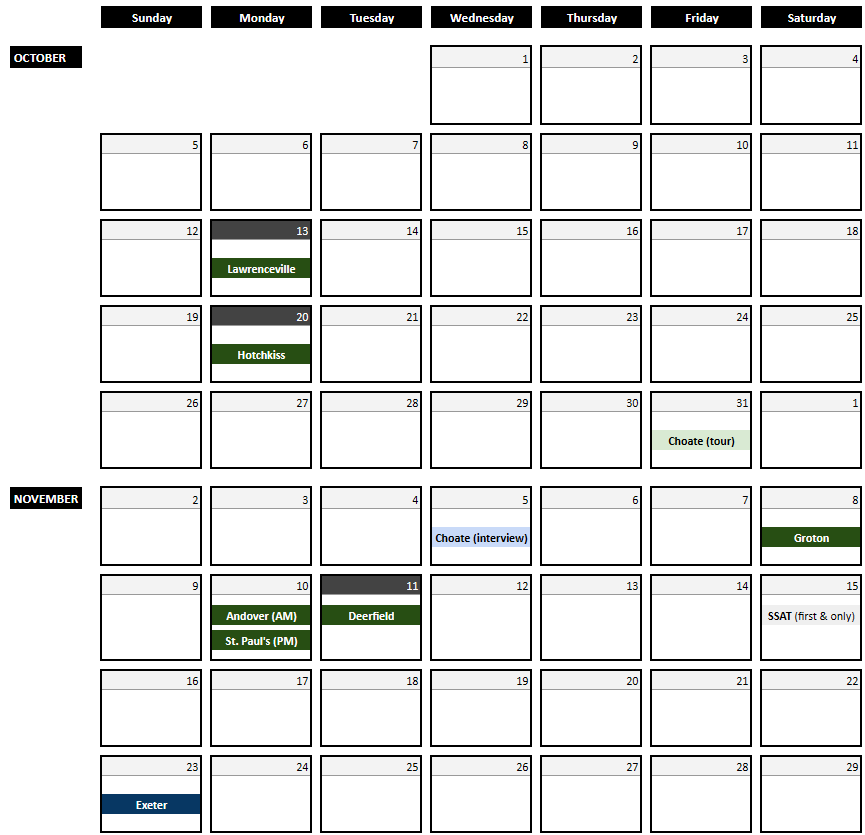
We did campus tours and interviews across five separate and distinct trips:
- Trip #1: Lawrenceville
- Trip #2: Hotchkiss
- Trip #3: Choate (tour only; virtual interview the following week)
- Trip #4: Groton, Andover, St. Paul's, Deerfield
- Trip #5: Exeter (in-person / semi-local interview)
Note: due to time constraints, we de-prioritized doing an on-campus tour of Exeter, since my daughter had done Exeter Summer. Candidly, despite her having spent a month at Exeter, after her first two campus tours, she expressed that she would have liked to formally do an Exeter tour, as she felt there was a palpable difference between how a campus feels during the summer vs. when the full student body, faculty, and administration are present and buzzing around.

Our Strategy
Our strategic approach to campus tours centered around two objectives.
Strategy #1: Tours precede interviews
We all agreed my daughter would visit a school prior to interviewing for it. We debated decoupling the tour and interview, which would have given us greater scheduling freedom; but we opted to keep them together. We wanted to do in-person interviews and did not have the time or ability to schedule incremental revisits or trips to semi-local interviews.
Keeping tours and interviews coupled meant we were slow to reserve slots. We began exploring dates in early / mid-September, after we'd set up a 'Gateway' application portal account, but held back on formal scheduling until the last week of September / first week of October. The delay was driven by my anxiety about wanting my daughter to feel adequately prepared before jumping into interviews.
Strategy #2: Grouping schools for efficiency
My second goal was a mix of logistics and personal strategy. Logistically, I wanted to design our trips based on groups of schools with reasonable proximity to one another. Strategically, I wanted to serialize our schedule to allow for my daughter to 'practice' her interview skills on schools she was initially less invested in.
Our original plan started with all eight target schools plotted on a map. I drew circles around the logical clusters, ordered the groups of schools I wished to visit based on my efficiency and prioritization strategy. I handed the map back to my husband to schedule the tours … across several weekends. I was actually also thinking about how we could probably piggy back a couple of the tours into a nice trip to visit a few friends in the Boston area.
Although my husband didn't wait too long before logging onto Gateway to begin looking at dates, once he did, the map and plan were immediately jettisoned. Instead of weekend optionality, we were faced with supply and demand reality. By the time we felt ready to commit to dates, we found ourselves entirely at the mercy of remaining availability. The slots were: (i) almost exclusively limited to weekdays (not even Fridays); and (ii) generally scarce overall.
Our new plan was to simply get what we could get and prioritize missing as few school days as possible. Our resulting schedule was a fractured set of one-off trips, and even one day where we were double-booked.
Our Preparation
I'm putting aside the preparation my daughter did for interviews. We kept prep for the campus tours light — focusing on two key actions to eek out as much value as we could from the limited time we had on campuses.
- Refresher and question generation: We re-reviewed the basic information for each school — academic profile, student body demographics, and unique programs. This helped us generate specific questions and topics we wanted to clarify with our tour guides.
- Templated school assessment: I created a templated worksheet and taped printed copies into the dedicated notebook my daughter kept to organize her thoughts and questions about each school. The purpose of the templated assessment was two-fold:
- Consistent framework: it provided a standardized way for her to categorize and organize the firehose of information she received at each campus visit.
- Quantifiable hot-take: in addition to sections for qualitative notes, it included dedicated space for her to document a hot-take, numerical assessment across each category. This quantification provided a concise 'score' that was easier to parse than her raw notes and offered an at-a-glance data point she could refer back to when it came time to compare schools.
2. What To Expect During Campus Tours — Observations Without Editorial
This section provides a summary-level description of the experience — without editorial (which I share in the next section).
Parent & Child Attire: comfortable, but sharp … is how I would describe both the kids' and parents' attire. Most parents donned business casual dress. Girls typically wore blouses and skirts or dresses. Boys wore khakis or trousers and a button down, and often a sport coat and tie.
- My daughter — whose wardrobe is almost entirely only t-shirts, leggings, and sweatpants, wore — for her bottoms, either black leggings + a skort, or linen navy trousers that I ordered specifically for these campus visits. For her top, she shifted between a couple pieces of my clothes: either a simple black blouse or light beige sweater. She wore sneakers.
- I wore fitted jeans, and either a blouse or sweater … except for during the Choate tour, where upon parking and reaching into the back seat, I became immensely embarrassed to realize that in the stir of leaving the house well before dawn, I had forgotten to bring the respectable coat that I was going to — at all times — wear over my sloppy gray 'home' sweatshirt, which is … double embarrassingly enough, ill-fitting, as the sweatshirt is actually a children's sized one discarded last year by my son.
Admissions Officer Attire: neat and professional, and never intimidating or business formal.
Tour Guide Attire: comfortable and mostly neat. Almost without exception, our tour guides (all students) were dressed in jeans — except for during our Choate tour, where several students were in Halloween costumes and/or spirit day attire.
- Deerfield has retained a more formal dress code policy. All students must wear 'appropriate' tops (e.g., collared shirts, blouse, dress), 'appropriate' bottoms, and a blazer or sportcoat; and in addition, boys must wear ties with their collared shirts. I asterisked 'must' because as I walked around campus, I was left with the impression that the scope of what is 'appropriate' appears to be far wider than what the Deerfield literature may have one believe. That said, our lovely guides were two girls (in jeans and loose sweaters); and the boys I did notice around campus were mostly in collared shirts and ties … tied loosely.
- Let me please caveat an Andover observation as a single, isolated data point. I was surprised at Andover by how 'college-y' the campus felt — both in terms of the layout, but also in terms of the students' attire. The majority of students I glanced at were in sweats. No judgement; I was simply reminded of my days in college.
Weather: dress accordingly and bring an umbrella if it's forecasted to rain.
- Situational note: St. Paul's kindly hands out SPS-branded umbrellas for your tour if it is raining.
Parking: Parking is easy (mostly outside / near by the admissions or main building). Choate's underground parking is not sign-posted well. When I drove past it a couple times, it looked — to me — like the lot was meant only for commercial / administrative vehicles; but perhaps I thought that because there was a small truck parked near the lot's entrance when I arrived. Transparently, the parking instructions outlined in the tour reminder e-mail Choate sends are clear; and had I read it more thoroughly (vs. going only by Google maps), I would have found the lot easily.
Arrival: Many schools have admissions in a separate building; some schools have their admissions offices integrated into a main / central building. Once you arrive, you check in for your tour (at reception), and are asked to hang out in the waiting area until your tour guide arrives.
- Arrive no less than ten minutes early for your scheduled tour.
- There is usually coffee / tea. Andover also had some scones (maybe they were muffins).
- You wait with other families, but are not in each other's spaces. Most of the waiting areas have multiple rooms, and are appointed with groups of chairs / tables, where you and your child can sit together in reasonable isolation.
- Sometimes they give the students name tags; often they did not. Tour guides find applicants / families by either visually scanning for name tags or if none are handed out, then calling the applicant's name aloud.
- Take advantage of the school literature that is scattered all over coffee and sitting tables. Often, there will be recent publications of the school's newspaper. There was also often copies of the same marketing material you likely received from having joined the school's mailing list.
Arrival at Groton: This was a nice enough touch to want to elevate into its own point. Parent volunteers are present in the intimate (one-room) waiting room, and intermingle with families. They have no agenda, other than to greet you warmly, strike up a conversation, and offer themselves as an outlet to ask anything. The parent volunteer I spoke to was terrific. My daughter and I had a nice conversation with her while waiting for our tour guide; and I had a second delightful conversation with her while my daughter was 'interviewing' with the Admissions Officer. The school is so small and intimate that the parent also knew our tour guide, whom I praised.
- I'm not sure if this is always the case, or if because our interviewer simply had a minute to spare; but also of note: the Admissions Officer whom my daughter and I met with came to introduce himself prior to the tour. I thought it was a nice and kind gesture for him to have broken the ice for us.
Tours: All our tours lasted c.30–40 minutes. There's walking, but it's never brisk. Tour guides bring you to most — if not all main buildings / facilities on campus.
- Some schools have buildings dedicated to an area of studies (e.g., STEM, humanities); at Groton, all core areas of studies and classes are held in their central school building.
- Expect to also walk through sports and arts / music facilities and buildings (expect the sports facilities at Deerfield to be impressively expansive).
- You'll also visit libraries / study halls; dining halls; and dorms — including usually also being able to peek into an actual dorm room.
- Tip / Reminder: if there is a particular area of study or sport or passion your child is keenly interested in, mention it, so that your tour guide can take you specifically to where that action takes place.
Tour Guide Pairing: Families are usually paired 1:1 with a tour guide. At Lawrenceville, there was supposed to be another family with my husband / daughter; but they did not show. The 1:1 ratio was a surprise to me, and was a real treat. The entire experience may feel intimidating to many; so it felt like a gift to not have to share the space or conversation with another family.
- Tour guides are students who have generously and graciously volunteered their time.
- The Admissions office is incredibly thoughtful (where they have the information and can be) when pairing your family with a tour guide. For example: at a couple of schools, our tour guide hailed from our home city; and at one school, our guide also attended the same K-12 school as my daughter.
- At some schools, tour guides were only and always upper classmen, who have volunteered to serve in this capacity as a leadership opportunity. At a couple of schools, the tour guides were freshmen and sophomores — though to be clear, the freshmen, despite only having been on campus a few weeks themselves, were very well-versed about the school.
- I initially hypothesized that tour guides might give an ultra-quick fit assessment of the applicant to Admissions; however, without substantiating this conclusion, I am confident my hypothesis was wrong.
Engaging with Your Tour Guide: your tour guide has tons to tell you. So, don't feel compelled to prepare questions in advance for the sake of it. Only prepare genuine questions. Otherwise, I have no doubt that follow-up questions will come from you and/or your child, as a natural result of all the information your guide shares with you.
- No questions or comments? Frankly, no worries. The tour guides not only seem to have a ton of information to share; but they also all seem to be good conversationalists, and will lead engagement with your child / you through informal, thoughtful, and fun questions about your child.
- Both parent and child should take advantage of not only how intimate the tour is (1:1), but also how candid and informal the tour guides are willing to be. Tour guides are self-selecting, and are there because they love the school enough to carve this time out of one of their 'free' periods of the day. But they are also still honest and opinionated, and eager to share their perspectives. I had zero qualms asking about things like: whether the campus feels like an echo chamber of certain ideologies; about how competitive / cut-throat the academic culture may or may not be; about whether they've compared experiences with friends (or siblings in several cases) who had gone to other boarding schools; about various support structures and what happens when someone may fall through the cracks; and about what other schools they applied to and how they decided upon this one. Regardless of question, our guides always responded without judgement, or were honest about not knowing.
- Get to know your tour guide as a person. My daughter mostly stuck to questions about the school and various programs. I asked a ton of personal questions: favorite tradition so far; current classes taken; favorite subjects / classes to date; how often they go home or their parents visit; favorite dining hall dish / foods; their sports; independent research projects; their experiences doing international trips with the school. As a general rule of thumb, people like to talk about themselves; and as a small thank you for their time, I also wanted to make the conversation enjoyable for the tour guides. But through these questions — although personal to the tour guides — we did nonetheless get really insightful data points about the school's day-to-day.
End of Tour: your guide will drop you back off in the waiting area, and will share their contact information. We thanked them profusely, wished them luck on their upcoming tests / projects, and my daughter sent a quick 'thank you' e-mail later that evening or the day after. If you've also scheduled an on-campus interview, your interviewer will find you shortly.
3. Observations — With Light Editorial
This section contains a set of random editorialized observations I had during the tours.
Feeling intimidated: Ngl, I think I felt more anxious than my daughter did. She seemed to navigate through the experience at face value. Perhaps because I was not even aware that there were such places like boarding and day schools until well into college, I struggled with a persistent sense of being out of place. While my professional background has helped me be structured and thoughtful about this entire process, it still felt like I was feeling my way through it while other families were following a playbook. I'll share one silly example of my imposter syndrome: while sitting in a waiting room (my daughter was with her interviewer), at one point, I overheard a student affirm to the interviewer greeting him that he did in fact coordinate his green tie to match Deerfield's school colors. It was humbling to have a pre-teen make me — an adult — feel like I was not put together enough. My anxieties, of course, are self-imposed; and despite them, the milieu in the waiting rooms was always neutral, if not mildly friendly.
Single children — often accompanied by both parents: only during our Groton tour / interview — which was scheduled on a Saturday — did I ever see siblings. It was always just a single child, who was the applicant. More often than not (for sure, >50%, if not >65% of the time), both parents were present. I'm not sure how this would be logistically possible (between work and siblings). My husband offered a good point that it's not uncommon to have singletons — meaning if our daughter was an only child, then there would be a greater (vs. zero) chance of both my husband and I being present.
Vibes: I mentioned that my husband advocated for campus visits as the only reliable way to gain a real sense for a school's culture. He was totally right.
- Noticeable differences: student personalities; Admissions and staff personalities; campus architecture and layout; building and dorm aesthetics; the surrounding area / towns — and the proximity (or not) to them. Each of these things contributed individually and in aggregate to the overall feel of a school.
- Less noticeable differences: during on-campus visits, you're privy to atmospheric detail that is not possible through other formats. Take these experiential observations for what they are. I am sharing not because I think hard conclusions can be drawn, but because I'd like to give slice-of-life examples of the ephemeral interactions and micro-observations you get from being on campus. There are five examples:
- "Hi": At three schools — St. Paul's, Deerfield, and Groton — students and faculty made it a point to vocalize a quick salutation when in passing. While touring St. Paul's, someone said "hi" to us from a decent distance. I asked our guide if she knew the person (she said, 'no'). I brought this anecdote up during my 'interview' with the Admissions Officer; and she said that intentionally greeting one another is a lovely thing that they do. And while I'm innately terribly introverted, I agree that the eye contact, smile, and verbalized 'hello' fosters a familial and intimate sense of community.
- Cleanliness: All schools were kept tidy (even dorm and common rooms). Still, some were immaculate (though never sterile). Interpret this how you may; my interpretation is that where there was a noteworthy dearth of detritus on the floor and pathways, there also seemed to be a correlation to a sense for civic duty, accountability for shared spaces, and palpable community.
- Student hustle and bustle: While at some schools, our tour overlapped with the end of one class and start of another; and so we got to see students in transit. At some schools, the students walked from one class / building to another largely by themselves; at others, they walked in small groups. Also interpret this how you may. I personally don't have enough data points to feel like I can draw a trustworthy conclusion; however, I will share an anecdote from visiting the campuses of the two colleges my older brother applied to. While at Brown, we saw students hanging out in groups, playing frisbee, and ambling to their destinations. At Yale, we saw students, binders in hand, walking — at a brisk pace — to their destinations. My brother went to Yale, and I did not attend either school, so I do not have a hard opinion, beyond the fact that students have individual personalities that also contribute to the overall student body personality.
- A place where everyone knows your name: I'm too young for the television show, Cheers, but am familiar with the title song. Some schools are big — in absolute values, such as by student population size or campus size. But even if big, some schools felt big, while others did not. This is another intangible, experiential observation that is difficult to share in a way that resonates. A few heuristic examples: (i) At St. Paul's, even though the campus is fairly sprawling — with dorms over a bridge on one end, and academic buildings and sports facilities on the other end — the campus as a whole felt intimate and familial; (ii) At a small handful of schools, in addition to running into peers, our guides also ran into faculty; (iii) At Andover, we went through our entire tour without interacting once with another student or faculty member / administration; (iv) At Groton — although it's a bit of a cheat, since each year has only c.90 students — not only was everyone greeting our guide by name, but they were also expressing their excitement about seeing her perform in a lead role of a play debuting later that evening.
- St. Paul's 100% residential model: Maybe this observation has stuck with me because I'm a working parent and have one kid who is really young. Nonetheless, I thought this experience was nice, and also a contributing factor to the 'familial,' community-minded vibe that SPS exudes. During our walk, across a bridge near a small body of water, a medium-size group of young children were clamoring over rocks and chasing one another. Our guide explained they're almost certainly children of faculty / administration, who — because of SPS's 100% residential model — live on campus.
Constants: this point emphasizes what I found to be a constant across all the tours.
- Students seemed to love being there, and also seemed to thrive being with each other. This was discernable through the myriad adorable micro-interactions you get to witness while your guide takes you around campus. Guides would run into classmates / friends, who would greet or gently rib them. Often, we encountered — from a distance — small groups of students studying together or leisurely chatting. And even though during our Andover tour, our guide did not run into any peers or faculty she knew or acknowledged, she clearly cherished her experiences at the school.
- Every single one of our tour guides were exceptionally impressive. They were earnest, honest, service-minded, warm, and encouraging. They were articulate and were thoughtful and contemplative when answering our questions. They were excited about learning. And they were all grateful for the opportunity to be a part of the school. I acknowledge guides are self-selecting; but I strongly believe they are representative of the overall student population — and of the incredible and nurturing faculty and administration that guide them.
Conclusion: This entire process — the seven campus visits / in-person interviews and one virtual interview, squeezed into seven weeks — was tough on my daughter and for our family. Yet my husband's counsel proved absolutely right: the on-campus visit was the only reliable way to gain a sense for each school's culture, personality, and fit. One cannot get those atmospheric details or observe student micro-interactions — which culminate into a truer vibe — from a website or brochure.
Our goal was to make the most of the significant time (and non-immaterial travel money) we invested in visiting campuses. With a sigh of relief, from the luxury of this being behind us, here's my retrospective:
What went well:
- Tours preceded interviews. On-campus interviews follow immediately after the tour, which means there's little time to deeply reflect on the experience. Even so, the tours gave my daughter essential context about each school's culture. For her, this missing piece was a major source of stress. But seeing the environment first hand — for even as briefly as the tours were — made her feel more honest about her impressions of and questions about the school that she shared during her interviews.
- Structured assessment tool: the template — even if not always used by my daughter — provided her with a helpful framework she used to consistently organize her thoughts and questions.
- Candid conversations with tour guides: using the 1:1 tour ratio to ask candid and personal questions gave us meaningful insights.
- Notice the small details, such as the way students interact with each other, tidiness, science research project descriptions hanging on walls or short student artist statements next to displayed pieces.
- If you do arrive pre-seeded with questions for your guide, ask them consistently at each school. This gives you a measurable, comparative data point. As one example: I asked at each school about how college counseling works, and what the ratio of college counselor to students was.
What we would do differently:
- Schedule the tours earlier, so we could have been one of those families that snapped up weekend availability. For us, since we were deadset on having tours precede interviews, this would also mean we would have had to prepare for interviews earlier (which is totally doable).
- Asked to see specific things: while it was worthwhile to see each school's theaters, it's not a passion of my daughter's. She is fairly passionate about art — and in particular, working with her hands. There were a couple of tours where we ended up needing to skip walking through the art studios, where I realize in retrospect was something we should have specifically asked to check out.